

Introduction
Let’s say you and a friend are both planning a trip to New York City.
Your friend is starting from Boston. There’s a direct train; it’s simple, quick, and straightforward.
But you? You’re starting from Boise.
No direct route. No easy connection.
So what do you do?
Do you take the same path your friend does?
Do you try to force a direct route that doesn’t exist?
Or do you first get to a larger hub, maybe Chicago or Denver, and then continue the journey?
Same destination. Very different starting points.
And that’s exactly how digital transformation works.
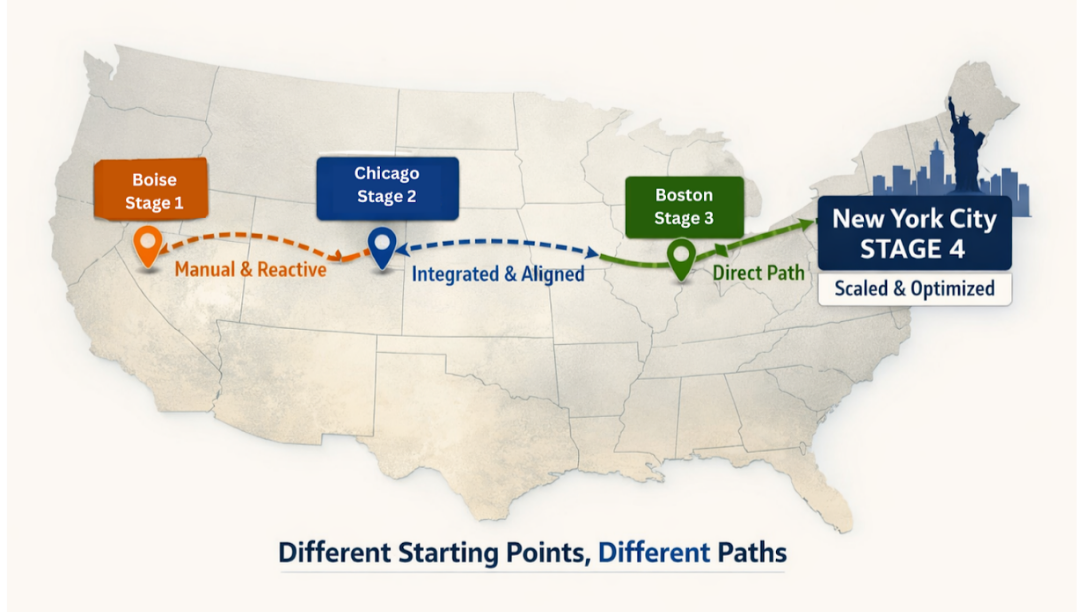
Most organisations are trying to reach the same outcome: better systems, faster decisions, and more efficient operations.
But where they start from determines what they should do next.
The problem?
Most companies don’t fail because they lack tools or intent.
They struggle because they take steps that don’t match their current stage.
In fact, research from Boston Consulting Group shows that only about 30% of digital transformations achieve their intended outcomes, often because organisations misjudge where they actually are in the journey.
That’s where things start to break.
- Tools get implemented, but don’t solve the right problems.
- Systems exist, but teams still rely on workarounds.
- Progress is visible, but impact is limited.
Not because the transformation is failing, but because it’s misaligned.
Before you decide what to do next, you need clarity on one thing:
👉 Where are you right now?
Digital Transformation Self-Assessment
Answer the following questions based on your organization’s current way of working.
For each statement, choose:
- 1 = Not true at all
- 2 = Somewhat true
- 3 = Mostly true
- 4 = Completely true
Section 1: Processes & Workflows
1. Our core processes are clearly defined and documented
2. Teams follow a consistent way of completing tasks
3. Workflows are structured and repeatable
Section 2: Tools & Systems
4. We use digital tools to manage key functions (sales, ops, etc.)
5. Our teams rely on systems more than manual tracking
6. We have minimal dependence on spreadsheets or chats for critical work
Section 3: Integration & Data
7. Our tools and systems are connected or integrated
8. Data flows smoothly across teams without manual effort
9. We have a single source of truth for key information
Section 4: Visibility & Decision-Making
10. We have real-time visibility into operations and performance
11. Reports and insights are easily accessible
12. Decisions are regularly driven by data
Section 5: Optimization & Adaptability
13. We continuously improve workflows based on performance data
14. We use automation to reduce manual work
15. We use data to predict trends or outcomes
Add up your total score:
- 15 – 30 → 🟦 Stage 1: Manual & Reactive
- 31 – 45 → 🟦 Stage 2: Tool Adoption
- 46 – 60 → 🟦 Stage 3: Integration & Alignment
- 61 – 75 → 🟦 Stage 4: Scaled & Optimized
How to Use Your Result
This isn’t about getting a “high score.”
It’s about understanding where you are today, so you can focus on what actually moves you forward.
👉 Once you have your score, jump directly to the stage that matches your current state.
Frameworks like those from Deloitte also emphasize that organizations progress through different levels of digital maturity, each requiring a distinct focus—from building foundational processes to enabling advanced, data-driven decision-making.
If you want a clearer breakdown of what your score actually means for your business, book a quick consultation and get a structured view of your current stage and next steps.
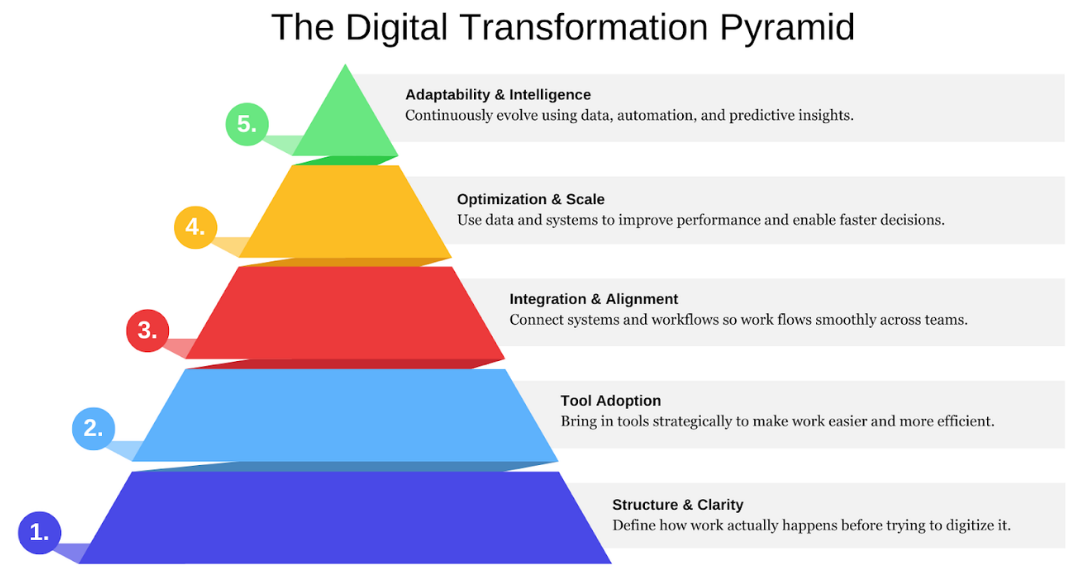
Before we go deeper into each stage, it helps to look at transformation as a layered progression.
Similar to how foundational needs must be met before higher-level growth, as seen in Maslow’s Hierarchy of Needs, digital transformation also builds upward, starting with structure and evolving toward adaptability.
Here’s a simple way to visualize it:
Stage 1: Manual & Reactive
(Early-stage / Small Teams / Unstructured Operations)
If your work depends on people more than systems, this is where you are.
At this stage, work gets done, but only because people are constantly pushing it forward.
There’s no system carrying the work.
Which leads to:
- Repetitive data entry
- No clear workflow
- Little to no visibility across the team
The problem isn’t effort. It’s the absence of structure. Organisations are still operating in a reactive mode, where processes are informal and heavily dependent on individuals. There is little standardisation, and most tasks are managed manually.
This is a common starting point for small businesses and growing teams. The focus is on getting things done quickly, which often means relying on spreadsheets, messages, and constant follow-ups instead of structured workflows.
While this approach works in the beginning, it becomes difficult to sustain as the volume of work increases.
What This Looks Like in Practice
- Tasks are tracked through spreadsheets, WhatsApp, or email
- There is no single source of truth for information
- Different team members follow different ways of doing the same task
- Work depends on constant reminders and coordination
- Important updates are often missed or delayed
Over time, this creates confusion, duplication of effort, and unnecessary delays.
👉 You’re not short on tools, you’re short on a system.
Example:
A small sales team manages leads through Excel sheets. Updates happen over calls and chats. Follow-ups are manual. Everyone tracks things their own way.
As volume grows:
- Data becomes unreliable
- Leads get missed
- Performance is hard to track
What’s Really Breaking (and Why Fixes Don’t Work)
In this setup, the issue isn’t just Excel. It’s what this way of working creates:
- Data scattered across places
- Follow-ups dependent on individuals
- No clear visibility into progress
From a management perspective:
- You can’t fully trust the data
- You don’t know where work is getting stuck
- And performance becomes difficult to measure
So naturally, the first instinct is: “We need a better tool.”
Teams try to fix this by:
- Adding a CRM
- Introducing task management tools
- Using more platforms to organize work
But nothing really improves because:
- The workflow itself is still unclear.
- So the same confusion just moves into a new system.
You haven’t fixed the problem; you’ve just digitised it.
This isn’t uncommon. In fact, in many service-driven operations, a significant portion of productivity is lost not because of effort, but because of how work is managed.
👉 A closer look at this problem:
So What Actually Fixes This?
What’s required here isn’t more tools.
It’s clarity on how work should move, before anything is implemented
Once that’s defined:
- You know what needs to be tracked
- You know where delays happen
- You know how tasks should progress
And then a system can actually support the work.
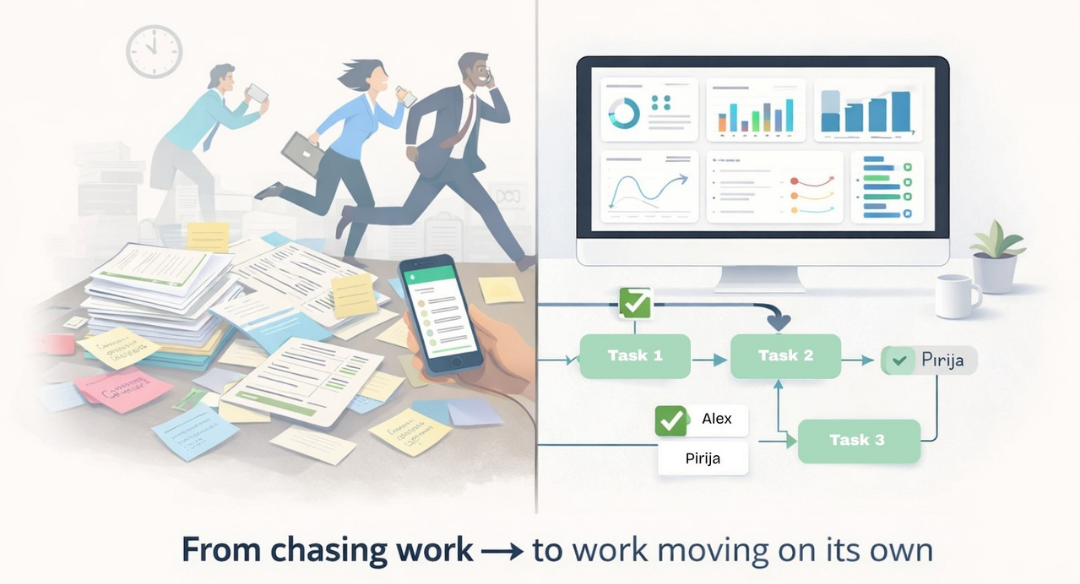
This is the turning point: You stop managing work manually and start building something that can run it.
How to Move Forward
At this stage, the goal is simple:
Take the way your business currently works, and turn it into a system that can run it consistently.
1. Make Your Workflow Visible
Right now, your workflow is scattered across people, chats, and sheets.
The first step is to bring it into one clear flow:
- What happens first
- Who does what
- What happens next
This is where gaps, delays, and inefficiencies become visible.
2. Structure It into a Working Model
Once the flow is clear, it’s structured into:
- Defined stages
- Task ownership
- Built-in triggers
So instead of people constantly pushing tasks forward, work starts moving based on a defined process.This reduces dependency on individuals and makes work more predictable.
3. Move Work into a Single System
Now comes the shift from “managing” to “running” work. Instead of Excel, WhatsApp, and scattered updates, everything moves into one centralised system.
This is typically enabled through platforms like AVIA, designed for workflow-heavy operations.
What changes here:
- Tasks move automatically through defined steps
- Follow-ups are no longer manual
- Work is tracked as it happens
- Everything is visible in one place
Work doesn’t just get recorded; it progresses on its own.
4. Introduce Tools, But the Right Way
Now, tools are introduced based on your workflow, not the other way around.
This means:
- No unnecessary complexity
- No unused features
- No confusion across teams
The system fits your work. Not vice versa.
For example:
- A basic CRM instead of multiple tracking sheets
- A simple task manager instead of WhatsApp follow-ups
New to this? Read: “Why Most Digital Transformation Efforts Fail (And What to Do Instead)”
Need help simplifying your setup?
Stage 2: Tool Adoption
(Growing Teams / Medium-Scale Organisations / Early Digital Efforts)
If you have tools but things still feel messy, you’re here.
At this stage, organizations have taken a big step forward. They’ve started using digital tools to manage work.
But instead of simplifying operations, something unexpected happens: Complexity increases.
What This Looks Like in Practice
- A CRM for sales, separate tools for operations and reporting
- Teams using different platforms with little coordination
- Some processes are automated, others are still manual
- Data exists, but is spread across multiple systems
- Teams switch between tools to complete a single workflow
On the surface, it feels like progress, but underneath, complexity begins to build.
To which Gartner also suggests that organisations often accumulate multiple disconnected tools over time, which increases operational complexity and reduces overall efficiency if not properly integrated
Example:
A growing company introduces a CRM for its sales team.
At the same time:
- The operations team uses spreadsheets to track delivery
- The finance team uses a separate system for invoicing
- Reporting is done manually by pulling data from different sources
Each team is working efficiently within their own system, but across the organisation:
- Data doesn’t sync
- Teams rely on manual updates
- Reports take time to compile
The organisation has tools, but not alignment.
What’s Really Breaking (and Why Fixes Don’t Work)
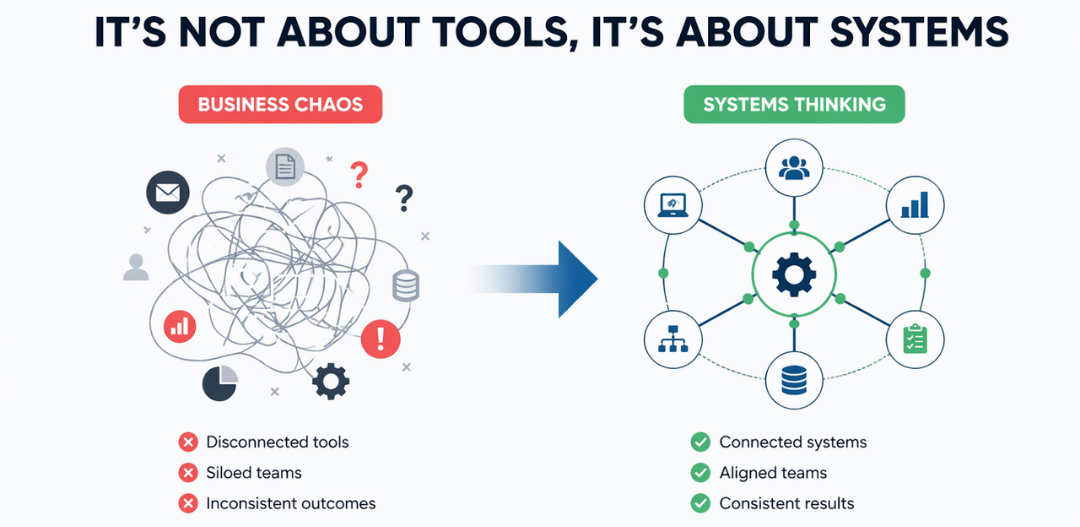
At this stage, the issue isn’t a lack of tools. It’s what multiple tools without coordination create:
- Duplicate data across systems
- No single source of truth
- Gaps between teams
- Limited visibility across workflows
From a management perspective:
- You’re constantly chasing updates
- You don’t fully trust the data
- And decision-making slows down
So the instinct is: “We need another tool to fix this.”
Teams try to solve it by:
- Adding more software
- Introducing new platforms for specific gaps
- Layering tools on top of existing ones
But the result? More systems. Same confusion.
Because:
- The tools exist, but they don’t work together.
- And the workflow across teams is still disconnected.
You haven’t simplified operations; you’ve spread them across systems. This is exactly where structured, platform-led workflows start making a difference.
Instead of adding more tools, the focus shifts to connecting and simplifying how work actually moves across teams.
How to Move Forward
The goal here is not expansion, it’s connection and alignment.
Now the goal is to bring connection and consistency into your setup.
1. Map Work Across Teams
Right now, each team works in its own system.
The first step is to map:
- How work moves from one team to another
- Where handoffs happen
- Where delays or gaps exist
This exposes where fragmentation is actually happening.
2. Align Tools with Real Workflows
Most tools are set up in isolation.
Here, the focus is to:
- Restructure tools based on actual workflows
- Ensure each system reflects how work really happens
- Remove unnecessary overlaps
Tools should support the workflow, not define it.
3. Connect Systems Where It Matters
Now, instead of manually moving data between tools:
Systems are connected, so information flows automatically.
This is typically enabled through platform-led approaches, AVIA is one such platform, where:
- Data syncs across systems
- Updates don’t require manual input
- Teams don’t need to chase each other for information
Work starts moving across tools as one continuous flow.
4. Simplify Before Expanding
At this stage, doing less is often more.
- Instead of adding new tools:
- Remove what’s not being used
- Standardise how existing tools are used
- Focus on adoption across teams
A well-connected system beats a stack of disconnected tools.
Key Question to Ask: “Are our tools working together, or are they creating more complexity?”
Once tools are connected, another shift begins:
It’s no longer about connecting systems; it’s about aligning them with business outcomes.
That’s where the focus moves next, from connection → to alignment.
If your current setup involves multiple tools but still requires manual coordination, it’s usually a sign that your systems aren’t working together yet.
Book a consultation to map how your current tools can be connected into a single, streamlined workflow across teams.
Stage 3: Integration & Alignment
(Structured Organisations / Systems Start Working Together)
If your systems work, but create friction, you’re here.
At this stage, organisations move beyond just using tools; they begin making those tools work together.
There is a clear shift from isolated systems to connected workflows. Processes become more standardised, and systems start reflecting how the business actually operates.
Work feels more structured, and there is greater visibility across teams.
However, while systems are now connected, they are not always fully aligned with business goals.
What This Looks Like in Practice
- Systems are integrated or partially connected
- Workflows are more standardised across teams
- Data is more accessible and consistent
- Reporting becomes faster and more reliable
- Teams rely more on systems than manual coordination
There is a noticeable improvement in efficiency, but some friction remains.
Example
An organisation integrates its CRM with operations and billing systems, now:
- Sales data flows into operations automatically
- Order processing is triggered without manual follow-ups
- Invoicing is linked to completed workflows
This reduces delays and improves coordination, however:
- Some workflows still require manual intervention
- Reporting is available, but not always aligned with key business metrics
- Teams use systems well, but not always in a unified way
The foundation is strong, but not fully optimised.
What’s Actually Breaking (And how to fix it)
At this stage, the issue isn’t integration. It’s alignment.
- Systems are connected, but not fully in sync
- Data is available, but not always decision-ready
- Workflows exist, but don’t always support outcomes
From a leadership standpoint:
- You can see what’s happening
- But not always act on it confidently
So the instinct becomes: “Let’s add better reports… more dashboards…”, but that doesn’t fix it.
Because the problem isn’t lack of visibility, it’s lack of alignment between systems, workflows, and goals. You’ve connected the system, but it’s not working as one.
This is where we step in. We don’t rebuild your systems.
We align everything you already have, so it works together, end-to-end.
1. Align Systems with Business Goals
Ask:
- Are your systems helping achieve key outcomes?
- Are you tracking the right metrics?
We map your systems to what actually matters.
So your systems don’t just function, they support decisions.
2. Optimise End-to-End Workflows
We look at how work moves across teams, not just within them.
- Where work slows down
- Where handoffs break
- Where effort is duplicated
Then we streamline it. So workflows don’t just exist, they flow.
3. Improve Cross-Team Visibility
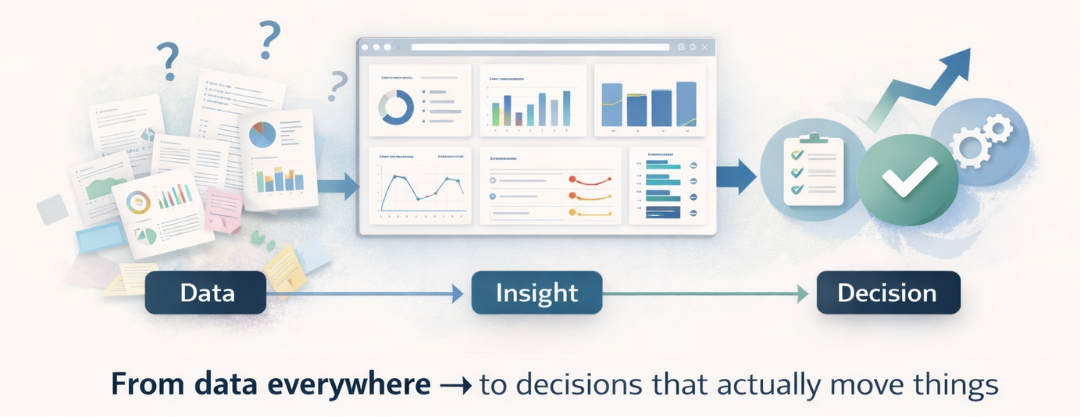
At this stage, visibility isn’t just about access to data. It’s about making that data usable for decisions.
Most organisations here already have dashboards, but:
- Data is scattered across systems
- Metrics don’t always align
- Insights require manual interpretation
So while visibility exists, clarity doesn’t.
This is where we step in. We bring your data into a structured analytics layer, where information is:
- Consolidated across systems
- Cleaned and standardised
- Visualised in a way that reflects real business performance
Instead of pulling reports from multiple sources, you get a single, reliable view of what’s happening across teams.
Platforms like AVIA can support the data flow, but the real value comes from how that data is:
👉 Structured
👉 Visualised
👉 Translated into decisions
So teams don’t just see data: they know exactly what to act on.
This level of clarity isn’t accidental, it comes from continuously refining how systems are designed and experienced.
A closer look at how platforms evolve to support this: Clearer, Flexible Platform Experiences & Stronger Operational Foundations
4. Define Ownership and Governance
As systems grow, clarity becomes essential.
- Who owns which process?
- Who is responsible for data accuracy?
- How are changes managed?
We align your data to these answers.
Without this, systems can slowly become inconsistent again.
Key Question to Ask: “Are our systems and workflows aligned with how we want the business to perform?”
Once data is structured and aligned, the next step isn’t understanding performance. It’s improving it continuously
If you have access to data but still struggle to turn it into clear, actionable insight, it’s usually a sign that your analytics layer isn’t fully aligned yet.
We’ll help you turn your existing data into a structured, decision-ready system.
Stage 4: Scaled & Optimized
(Mature Organisations / High-Performance Systems)
If your systems are helping you make decisions, not just manage operations, you’re here.
At this stage, digital transformation is no longer an initiative; it’s part of how the organisation operates.
Systems are fully integrated, workflows are streamlined, and data is consistently used to drive decisions.
The organisation is no longer reacting to inefficiencies; it is proactively improving performance.
What This Looks Like in Practice
- High adoption of systems across all teams
- Real-time visibility into operations and performance
- Seamless data flow across systems
- Faster, more confident decision-making
- Minimal manual intervention in routine processes
Work feels smoother, but performance isn’t always maximised.
Example
A mature organisation has fully connected its systems across sales, operations, finance, and reporting, now:
- Data flows automatically across all stages of work
- Dashboards provide real-time insights into performance
- Leadership can identify issues and act quickly
- Teams focus more on strategy than coordination
Instead of managing operations, the organisation is actively optimising them.
As highlighted by research from MIT Sloan Management Review, organisations that effectively use data for decision-making are significantly more likely to achieve higher productivity and performance outcomes.
What’s Actually Breaking (And how to fix it)
At this stage, the issue isn’t systems. It’s how performance is being managed.
- Data is available, but not fully leveraged
- Insights exist, but aren’t consistently acted upon
- Growth starts introducing complexity
From a leadership perspective: You can see performance, but not always improve it continuously
So the instinct becomes:
- Add more automation
- Add more layers
But that often creates:
- Unnecessary complexity
- Reduced flexibility
- Slower adaptability
You’re operating efficiently, but not optimising consistently
This is where we step in. We don’t add more systems. We refine how your existing setup performs through structured, advanced analytics and continuous improvement.
The focus here is on continuous improvement, not constant expansion.
1. Optimise, Don’t Overcomplicate
We identify what actually drives performance.
- Remove redundant metrics
- Focus on high-impact KPIs
- Align tracking with business outcomes
So your data reflects what truly matters.
2. Use Data for Proactive Decisions
We go beyond reporting.
- Identify patterns in performance
- Highlight inefficiencies and missed opportunities
- Continuously refine workflows based on real data
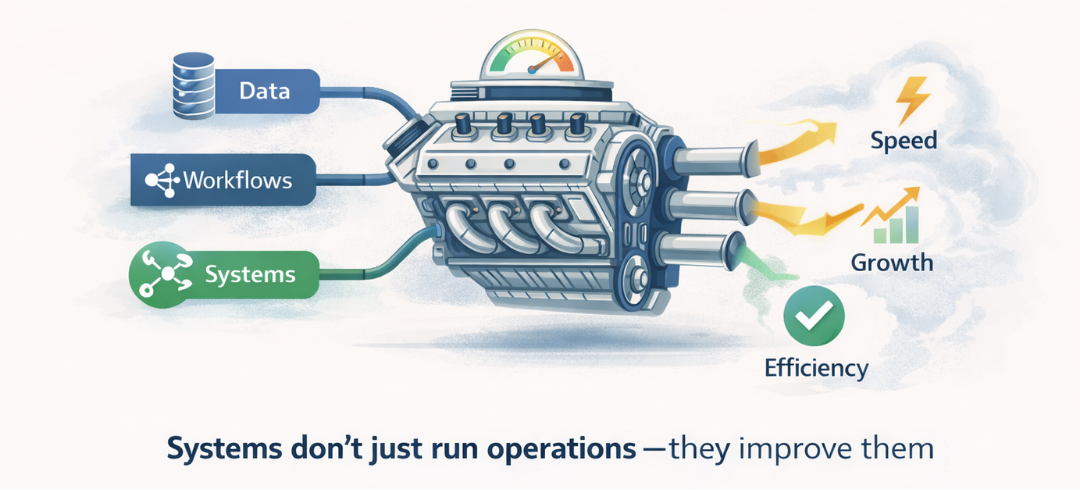
So your systems don’t just track performance, they improve it.
3. Scale Thoughtfully
As operations grow, complexity usually follows. So a smart move would be to
- Ensure systems can handle growth
- Maintain simplicity as you expand
- Avoid adding tools unless necessary
4. Continuously Improve Adoption
Even in mature systems, usage gaps appear.
Make sure to address:
- How teams interact with systems
- Where processes break down
- How data is actually used in decisions
So your systems continue delivering value over time. Transformation is ongoing, not static.
Key Question to Ask: “Are we using our systems to continuously improve, or just maintain?”
If your systems are running, but not improving performance
Book a consultation to identify where your data isn’t translating into outcomes.
What Comes Next
For some organisations, the journey doesn’t stop at optimisation.
As systems mature, the focus shifts toward adaptability, using data, automation, and evolving processes to continuously improve and respond to change.
So what does that actually look like?
It means:
- Using data not just to track performance, but to predict what’s likely to happen next
- Automating decisions where possible, not just tasks
- Continuously refining workflows based on real outcomes
- Adapting quickly as business needs change
At this stage, transformation is no longer a project. It becomes part of how the organisation operates and evolves.
As highlighted by Hinduja Global Solutions, organisations at this level fully embrace a digital-first mindset, continuously adapting to new technologies, using advanced tools like AI and analytics, and proactively responding to market changes.
But getting there doesn’t start with advanced tools. We support this shift by:
- Strengthening your analytics foundation
- Ensuring your data continues to evolve with your business
- Helping you move from performance tracking → to forward-looking decision-making
So your systems don’t just support growth. They help you stay ahead of it.
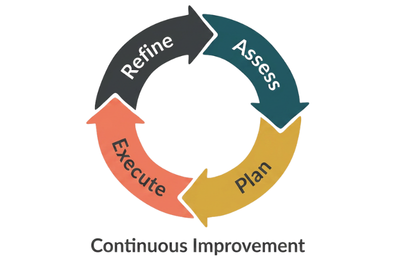
It starts with taking the right step, based on where you are today. The difference isn’t in how much you invest, it’s in whether you’re solving the right problem at the right stage.
The goal isn’t to become more digital, it’s to become more adaptive.
Once you know your stage, the next question is simple: what actually needs to change, and how do you get there?
Stage | What’s breaking | What needs to change | How can we help |
Stage 1: Manual & Reactive | Work depends on people, spreadsheets, and constant follow-ups | Lack of structure and no clear workflow | We map your workflows, structure them into clear processes, and implement a centralised system (via platforms like AVIA), so work moves without manual pushing |
Stage 2: Tool Adoption | Multiple tools, but work still feels messy and disconnected | Fragmented systems and poor coordination across teams | We align tools with actual workflows, eliminate redundancies, and connect systems so data flows seamlessly across teams |
Stage 3: Integration & Alignment | Systems are connected, but decisions still feel unclear | Data exists, but it isn’t structured for decision-making | We integrate and consolidate your data, build a structured analytics layer, and align systems with business goals so insights become actionable |
Stage 4: Scaled & Optimised | Strong systems, but performance isn’t consistently improving | Data is underutilised, and optimisation is inconsistent | We refine your analytics, identify performance gaps, and continuously optimise workflows so your systems actively improve outcomes |
👉 If you see your stage here but aren’t sure how to execute it in your context, a quick consultation can help map your exact next steps.
If you’re looking to move toward this level of adaptability, start with a clear view of where you stand today. We’ll help you map your current stage and outline what it takes to move forward with clarity.
Frequently Asked Questions
If your work is mostly manual, you’re likely in Stage 1.
If you use tools but things feel disconnected, you’re in Stage 2.
As systems become integrated and drive decisions, you move into Stages 3 and 4.
Use the self-assessment in this article to assess your organisation’s stage and needs.
Not effectively. Skipping foundational stages (like defining workflows) often leads to poor adoption, fragmented systems, and wasted investment later.
Introducing tools before defining processes. This leads to digitising confusion instead of improving how work actually happens.
Because tools alone don’t create alignment. Without integration and clear workflows, more tools often increase complexity rather than reduce it.
Once multiple tools are being used across teams.
If data is scattered and teams rely on manual updates, it’s a clear sign you need to move toward integration (Stage 3).
It means decisions are based on real-time data and insights, not manual reports or assumptions.
At this stage, systems don’t just support work, they actively guide it.
No. In fact, smaller organisations benefit the most by building the right foundation early, avoiding complexity as they grow.
There’s no fixed timeline. It depends on your starting point, complexity, and how structured your approach is. The focus should be on steady progress, not speed.
- Stage 1 → Clarity and structure
- Stage 2 → Tool alignment and adoption
- Stage 3 → Integration and workflow optimisation
- Stage 4 → Data-driven decision-making and scaling
Critical. Even the best systems fail if teams don’t use them consistently. Adoption is what turns implementation into real impact.
Digitisation = moving processes to digital tools.
Transformation = improving how the business operates using those tools.
Focus only on the next step, not everything at once. Each stage has a clear priority. Solving that well is what moves you forward.
If you’re unsure what that next step looks like in your context, it can help to get an outside perspective; sometimes, a quick consultation is enough to bring clarity to where to focus next.
Platforms like AVIA are especially useful in early to mid stages, where operations are still workflow-heavy and manual.
They help by:
- Structuring and automating workflows
- Centralising task and ticket tracking
- Improving visibility across day-to-day operations
- Have inbuilt analytics
👉 Instead of managing work through scattered tools, everything moves through a single, structured system, making execution faster and more consistent.
Analytics is critical from Stage 1. Without it:
- Data exists, but doesn’t guide decisions
- Reports are available, but lack clarity
- Teams operate, but don’t always improve
With the right analytics layer, Data becomes structured, comparable, and decision-ready. This is what enables:
- Better performance tracking
- Faster decision-making
- Continuous improvement
We don’t take a one-size-fits-all approach. Instead:
- We assess where you are
- Identify what’s holding you back
- Align systems, workflows, and data accordingly
This can include:
- Workflow structuring and automation (AVIA-led)
- System alignment and operational coordination (execution-led)
- Data consolidation and analytics
👉 The goal is simple: make your existing setup work better, before adding anything new.