

Introduction
Digital transformation has been a boardroom buzzword for over a decade now, invoked in strategy decks, promised in vendor pitches, cited in investor calls since the mid-2010s. And yet, for many industrial businesses, the problem in 2026 still isn’t access to digital technology. It’s knowing where to deploy it first and how to connect each initiative to a measurable operational outcome, rather than another line in a slide deck. ERP, MES, IIoT sensors, AI, and cloud platforms can each create real value on their own, but introduced without a shared strategy behind them, they tend to produce another layer of disconnected systems rather than genuine transformation.
A decade of repetition hasn’t made this easier. If anything, it’s made “digital transformation” a harder phrase to take seriously on shop floors that have already sat through a few rounds of it without much changing. This guide is built for that scepticism. It walks through how manufacturing, telecom, and infrastructure businesses can build a digital transformation strategy that actually sticks, one grounded in operational reality and sequencing, not technology for its own sake.

What's Changed
Earlier waves of digital transformation often stalled because they were IT-led rather than business-led. A new ERP system or a dashboard rollout would go live, but the shop floor kept running the way it always had. Two structural shifts have already changed that dynamic:
- Labour and skills shortages are forcing plants to automate for survival, not novelty, and
- regulatory and sustainability reporting requirements now demand real-time data that spreadsheets can’t produce.
But the shift changing the calculus most is the kind of AI now on the table.
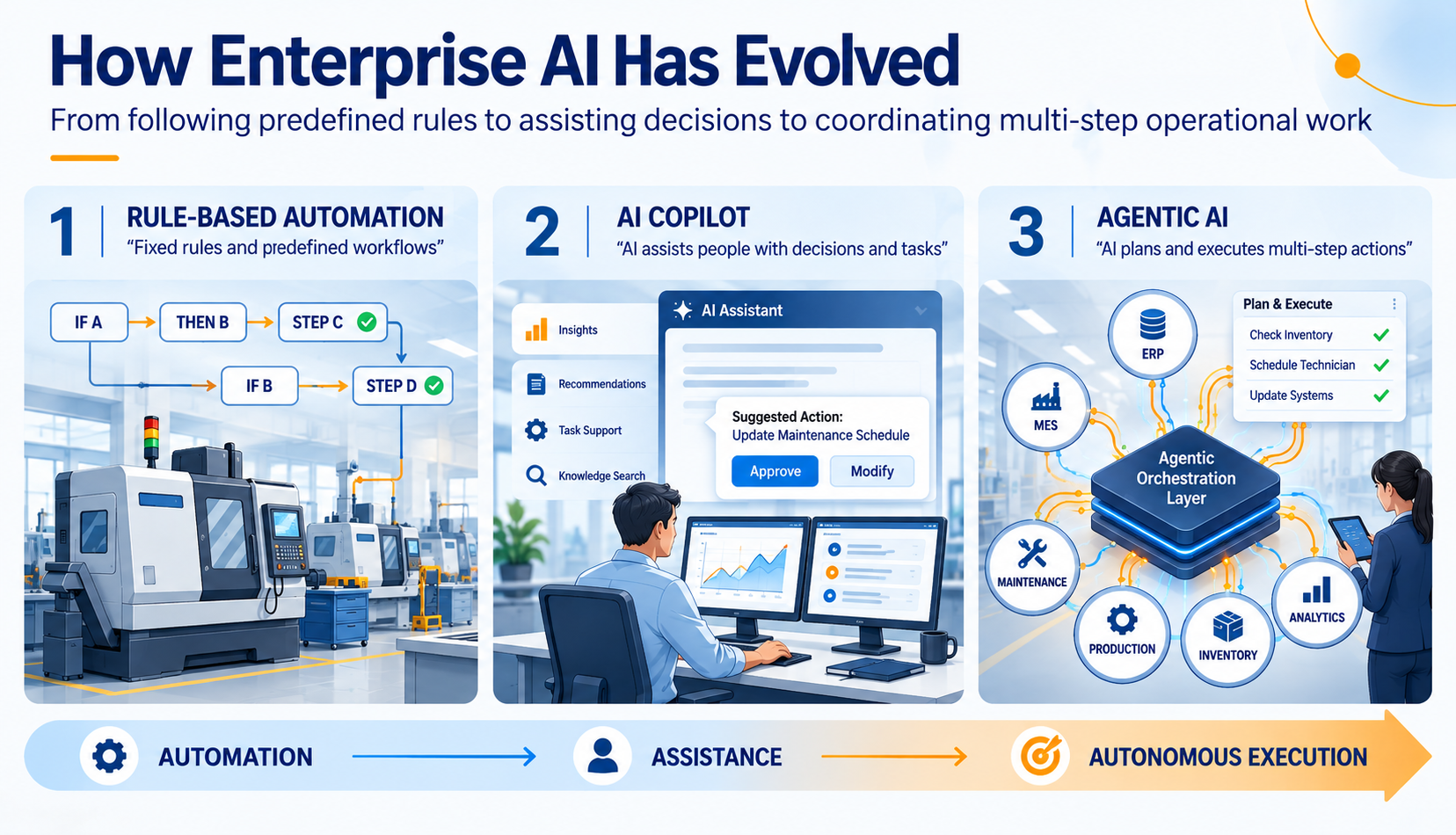
Enterprise AI has moved through three distinct phases.
- The first was rule-based automation, rigid, scripted, and quick to break the moment a request didn’t match its script.
- The second was the “copilot” era: generative AI that could draft, summarise, and suggest, but stayed structurally passive; a person still had to read the output, decide, and act on it.
- The current phase is different in kind, not just degree. Agentic AI can plan multi-step actions and carry them out directly across connected systems, escalating to a human only when a task exceeds its defined scope, rather than waiting for approval at every step.
Manufacturing is where this is showing up first. Salesforce’s Agentforce for Manufacturing offers prebuilt AI agents that help manufacturers scale without adding headcount, built for an industry Salesforce describes as hitting a breaking point, nearly 70% of manufacturers are still constrained by manual data entry. That shift raises the stakes on everything this guide covers: an agent that recommends a bad decision costs minutes to fix; one that acts on bad data can shut down a line before anyone notices.
The stakes for getting this right are real, and the failure rate is well documented. Though it’s worth being precise about what the research actually shows. BCG’s 2020 study of 800 executives and 70 transformations in detail found that only around 30% of digital transformations fully achieve their objectives, meaning roughly seven in ten fall short in some way, though most of those still generate some value along the way, so “falls short” isn’t the same as “produces nothing.” McKinsey’s own global survey set an even tighter bar: only 16% of respondents say their transformation both improved performance and sustained that improvement over time.
Scaling is where a second wave of failure tends to hit, even after a pilot succeeds. McKinsey’s manufacturing research has found that fewer than a third of digital initiatives that start as pilots are ever implemented at scale. None of this is an argument against transformation. It’s an argument against the disconnected, technology-first approach that causes most of these failures.
The organisations succeeding this year are the ones treating transformation as a continuous operating model, not a one-time IT project. AI is making technology adoption faster than ever, but that makes strategy, data quality, and governance more important, not less. Speed without a foundation just means moving faster toward the wrong outcome.
Step 1: Anchor the Strategy to Business Outcomes, Not Technology
Before evaluating any platform or vendor, define what “transformed” actually means for your business in measurable terms, and that definition looks different by vertical. A manufacturer might target reduced unplanned downtime or improved first-pass yield. A telecom operator might target reduced network or service downtime. An infrastructure or field-service business might target faster response times to service calls. Every subsequent decision- which systems to modernise first, which data to prioritise- should trace back to one of these outcomes.
This means building a problem-first strategy, not a technology-first one. Instead of “we need AI,” ask “what decision or process could AI actually improve?” Instead of “we need IoT,” ask “what operational visibility are we currently missing?” A simple problem inventory keeps this discipline visible across verticals:
Business challenge | Operational impact | Potential digital response |
Manual production tracking | Delayed visibility | Digital shop-floor tracking |
Disconnected systems | Duplicate data entry | System integration |
Unplanned downtime | Lost capacity | Machine monitoring / predictive analytics |
Network fault detection lag | Extended service downtime | Automated network monitoring and alerting |
Delayed field-service dispatch | Missed SLAs | Real-time technician tracking and scheduling |
A useful test: if a proposed initiative can’t be tied to a specific operational or financial metric, it doesn’t belong in phase one.
Step 2: Audit Your Current Technology and Data Landscape
Most manufacturing, telecom, and infrastructure operations run on a patchwork of legacy SCADA systems, disconnected ERPs, spreadsheets, and point solutions accumulated over years. Before adding anything new, assess the landscape honestly across five areas, not by counting how many platforms are already in use, but by how effectively technology actually supports the business:
- Processes — where are things still manual, still running on spreadsheets or paper, or slowed by handoffs?
- Data — where is data stored, is it connected, and is the same information entered more than once?
- Technology — what systems already exist, which are underused, and where are the integration gaps?
- People — which processes rely on individual tribal knowledge rather than documented process, and where might employees resist new workflows?
- Performance — hard metrics: cycle time, downtime, throughput, inventory, quality, rework, utilisation.
This audit typically surfaces the biggest early win: connecting existing systems rather than replacing them outright.
For a broader view of where your organisation sits before you start this audit, read Where Are You in Your Digital Transformation Journey? (And What to Do Next)

Step 3: Translate Problems into Measurable Objectives
Once the biggest gaps are visible, turn them into specific, measurable objectives rather than broad ambitions. “Digitise manufacturing” isn’t an objective; it’s a direction. “Reduce production reporting delays by 40% across three plants within 12 months” is.
Each objective should define what, by how much, by when, and in which process. This also creates the baseline needed to measure ROI once initiatives go live, rather than trying to reconstruct one after the fact.
Who builds this business case matters more than most teams expect. McKinsey’s survey found that when the business case is developed by genuine subject-matter experts rather than a program management office with limited operational context, success rates roughly double, from around 18% to around 47%.
Step 4: Build Cross-Functional Ownership Early
This step answers a simple question: who needs to be involved before anything gets built? Digital transformation initiatives led solely by IT tend to produce tools nobody on the floor wants to use. Involve operations, quality, maintenance, and frontline supervisors from the design stage, not after rollout. Their input determines whether a new system fits existing workflows or forces workarounds that quietly kill adoption.
Appointing a cross-functional steering group, with real decision-making authority, not just advisory input, is one of the strongest predictors of whether a transformation program survives past its first year. Ownership should be explicit: who owns each initiative, who owns the underlying data, and who approves changes.
Step 5: Prioritise Initiatives and Build the Roadmap
Not every process needs to transform at once, and enterprise-wide overhauls are high-risk and slow to show value. Prioritise initiatives using two dimensions:
- Business impact — how much the initiative could improve revenue, cost, productivity, quality, or risk.
- Implementation effort — cost, technical complexity, integration requirements, and organisational disruption.
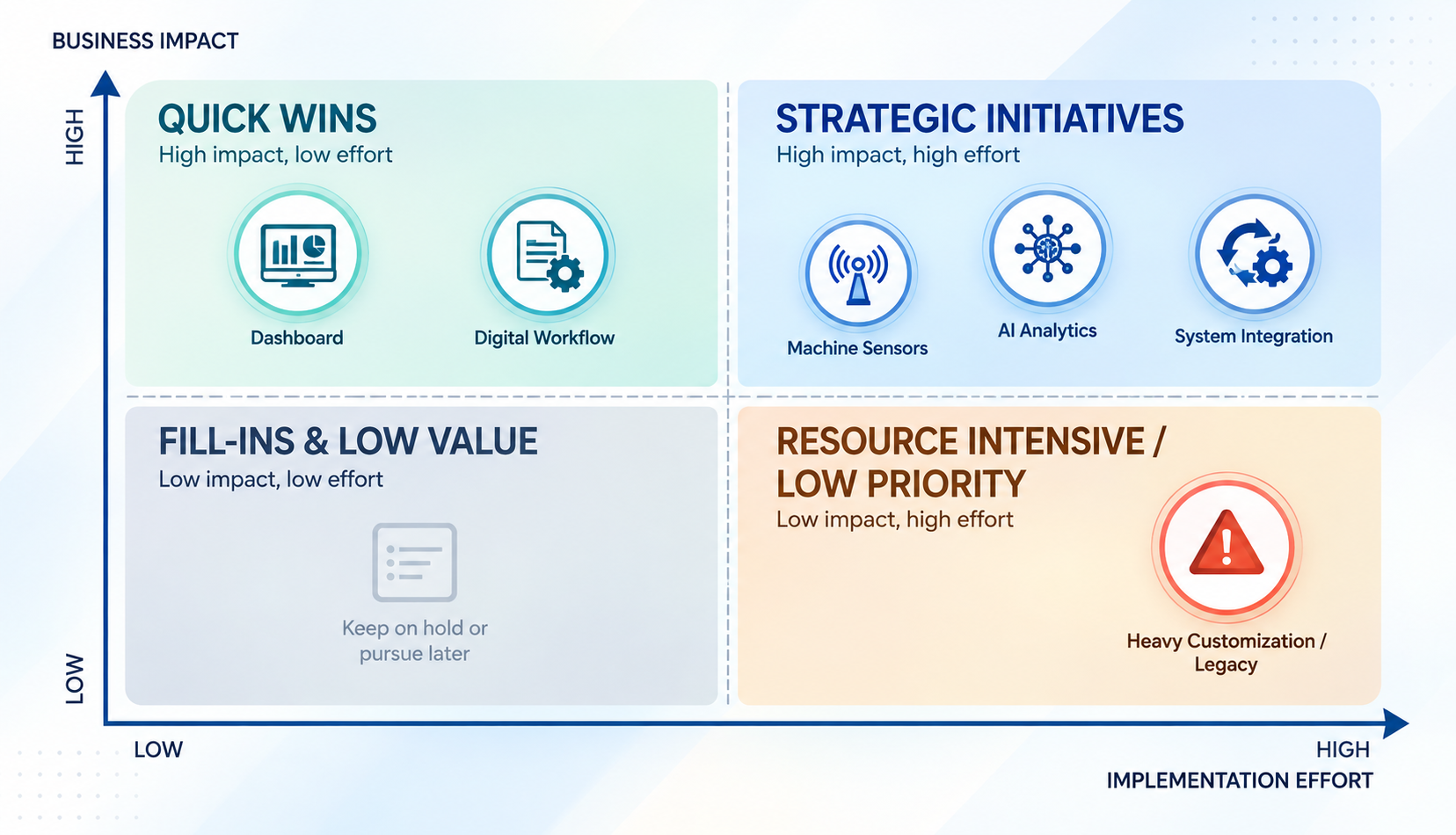
This sorts initiatives into quick wins (high impact, low effort), strategic initiatives (high impact, high effort worth the investment), and low-priority initiatives (low impact, high effort) — keeping the roadmap from becoming a long list of unrelated projects competing for the same budget.
From there, sequence the roadmap into four broad phases: pilot a single, well-scoped use case; measure the results; standardise what works; then expand with lessons baked in. Step 9 covers how to actually execute that sequence.
If cost is the harder half of that equation for your team, our piece on why digital transformation gets expensive covers what typically drives it up, and how to keep it in check.
Step 6: Strengthen the Data Foundation
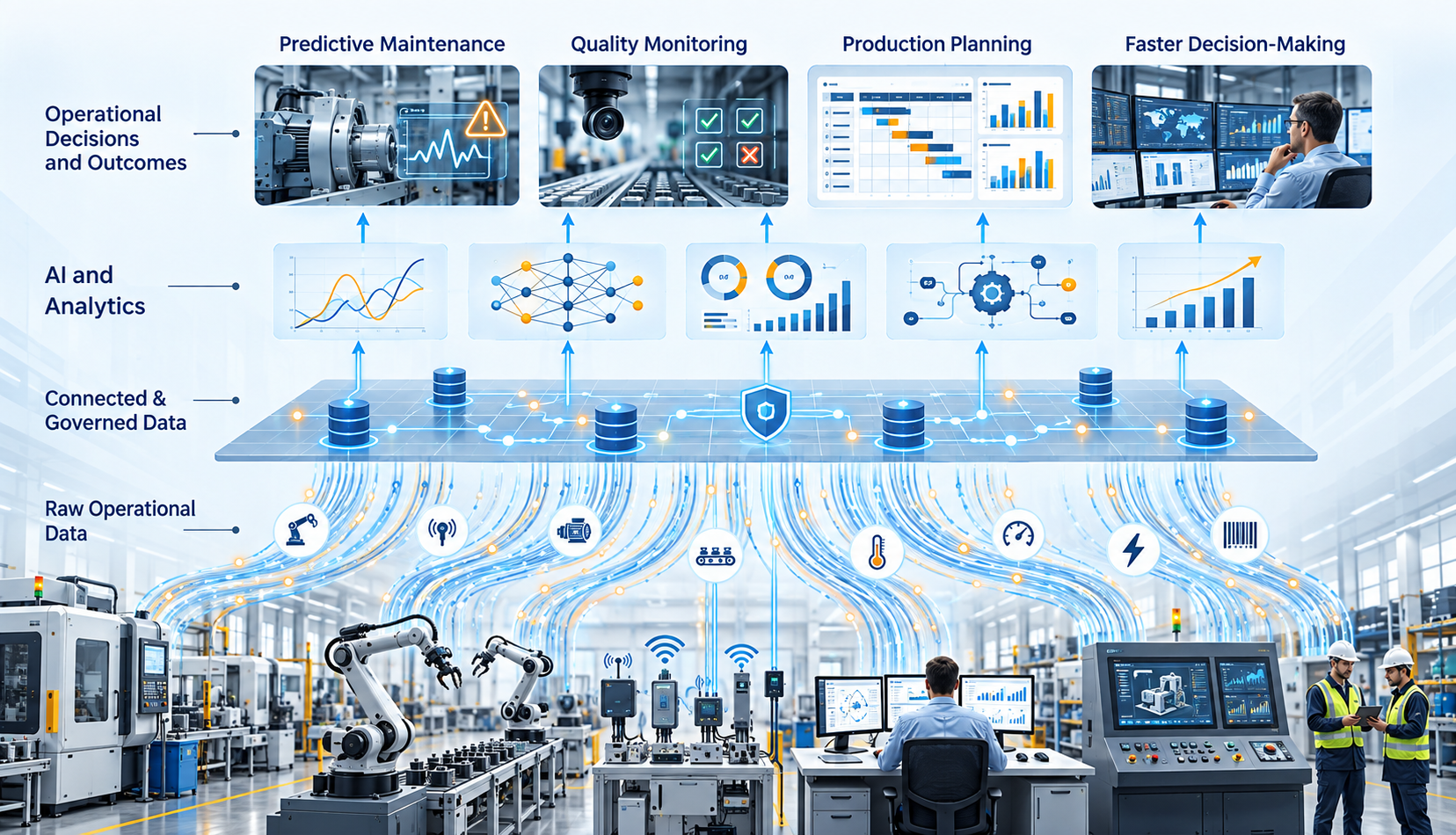
AI-driven predictive maintenance, demand forecasting, and quality inspection tools are only as good as the data feeding them. Many transformation efforts fail here, jumping to advanced analytics or AI pilots on top of inconsistent, siloed, or poorly labeled data.
The failure pattern is a simple chain: unreliable data produces unreliable analytics, unreliable analytics erodes trust, and once floor staff stop trusting the outputs, they stop using the tool, regardless of how sophisticated the underlying model is.
Before layering on AI capabilities, confirm:
- Sensor and machine data is being captured consistently and at the right frequency.
- Data from different systems (ERP, MES, SCADA, IIoT platforms) can actually be joined together.
- There’s a clear data governance owner responsible for quality and accessibility.
The upside of solving this first is real. Manufacturing downtime is expensive; ABB’s 2023 Value of Reliability survey of more than 3,200 plant maintenance leaders puts the median cost of unplanned downtime at roughly $125,000 per hour across industrial sectors – which is exactly the kind of number that makes the upfront work of a solid data foundation worth it, provided that foundation is actually feeding trustworthy analytics rather than papering over gaps in the underlying data.
Step 7: Select Technology Based on Use Cases
Vendor selection is where many strategies quietly go wrong. A platform with the most features isn’t useful if it doesn’t solve the problem identified back in Steps 1–3. A simple decision chain keeps selection disciplined:
business need → required capability → technology → integration → cost → expected outcome
Evaluate potential technologies on:
- Whether it solves the specific problem identified earlier – not just what a vendor’s feature list promises
- Flexibility to scale from a single-site pilot to multi-site deployment
- Domain expertise in your specific vertical (manufacturing, telecom, or infrastructure operations), not generic enterprise software
That last point is where a lot of standard enterprise software falls short: a platform built for generic workflow or ERP needs rarely understands the operational nuances of a manufacturing floor, a telecom network, or a field-service operation the way vertical-specific expertise does. It’s also why Axxonet’s own work stays anchored to these three verticals rather than trying to be a general-purpose systems integrator.
Step 8: Connect the Digital Ecosystem
Transformation rarely means replacing ERP, MES, SCADA, or CRM systems outright. The real challenge — and the real opportunity — is making information flow reliably between them: ERP → planning → production → quality → inventory → analytics.
When that chain breaks anywhere along the way, it shows up as:
- Duplicate data entry across systems that don’t talk to each other
- Delayed information that arrives too late to act on
- Manual reconciliation eating hours that should go toward higher-value work
- Poor cross-functional visibility into what’s actually happening on the floor
- Inconsistent decisions made on inconsistent versions of the same data
Connecting the ecosystem doesn’t require a single unified platform. It requires deliberate integration, APIs, middleware, or purpose-built connectors, designed around the specific data flows the business actually needs, rather than an assumption that one new system will somehow absorb everything that came before it.

Step 9: Pilot, Measure, and Scale
With priorities set and the ecosystem connected, execution follows a deliberate sequence:
- Pilot a single, well-scoped use case (e.g., predictive maintenance on one production line, or a unified dashboard for one facility).
- Measure results against the Step 1 outcomes with real data, not projections.
- Standardise what works before scaling it across additional lines, plants, or regions.
- Expand with lessons from the pilot baked into the rollout plan.
This sequencing keeps budget requests smaller and easier to justify at each stage, rather than requiring one large upfront commitment. It also directly addresses the pilot-to-scale gap flagged earlier: most pilots never make it to scale, typically because the transition from a single-line proof of concept to a multi-site rollout was never actually planned for, it’s treated as a future problem rather than part of the roadmap from day one.
Measurement needs to go beyond technology metrics too. “We deployed a dashboard to 500 employees” is not an outcome. “Production managers reduced response time to production deviations by 30%” is. Track four categories:
- Financial — cost reduction, revenue impact, ROI, payback period.
- Operational — cycle time, throughput, downtime, utilisation, schedule adherence.
- Quality — defect rate, rework, first-pass yield, customer complaints.
- Adoption — system usage, workflow completion, employee adoption rate.
Step 10: Build Change Management and Continuous Governance
Technology rollouts fail more often from human resistance than technical limitations. Employees may resist because workflows are shifting, responsibilities are changing, they don’t understand the benefit, or they weren’t involved in the design. Countering that takes leadership sponsorship, genuine employee involvement in the design itself, training on the new workflow (not just the software), and feedback loops that give teams a real mechanism to flag problems, scheduled into the project plan with the same rigour as the technical implementation, not squeezed in during the final week before go-live.
Governance doesn’t end at rollout either. Set a regular cadence; quarterly is typical, to review performance against the original objectives, retire tools that aren’t delivering value, and identify the next phase of the roadmap. Treating transformation as an ongoing operating model, rather than a project with an end date, is what separates organisations that keep compounding gains from those that plateau after the first win.
Common Digital Transformation Mistakes to Avoid
A handful of failure patterns show up again and again, regardless of industry or company size:
- Starting with technology before the problem is defined.
- Transforming everything at once, with no sequencing between initiatives.
- Ignoring legacy systems, assuming they can simply be replaced rather than integrated.
- Treating data as an afterthought, then building analytics or AI on top of it anyway.
- Making transformation an IT-only initiative, sidelining the operational teams who actually use the systems.
- Measuring deployment instead of outcomes, like counting users or dashboards rather than business improvement.
- Running pilots without a scaling plan, proving something works without ever defining how it becomes sustainable.
[Further reading: Why Most Digital Transformation Efforts Fail (And What to Do Instead) ]
Takeaway
The manufacturing, telecom, and infrastructure businesses gaining ground this year aren’t necessarily the ones with the biggest technology budgets, they’re the ones with the clearest line from strategy to shop floor. A digital transformation roadmap built on measurable outcomes, cross-functional buy-in, and a disciplined phased rollout will outperform an ambitious but disconnected overhaul every time. The underlying philosophy is simple: don’t digitise the complexity; understand it, structure it, connect it, and then automate or optimise it.
If you’re mapping out where to start, Axxonet works with businesses to design digital transformation roadmaps grounded in operational outcomes, not feature checklists.
Talk to our team about scoping your first 90 days.
Not sure whether your current setup needs modernising or just needs to be used better?
And we'll help you find out.
Frequently Asked Questions
A digital transformation strategy is a structured plan for using digital technologies to solve specific business and operational problems. It defines the organisation's current digital maturity, transformation objectives, priority initiatives, technology requirements, implementation roadmap, and measures for success.
Start by assessing current processes, systems, data, and operational performance. Then identify the biggest business problems, define measurable objectives, prioritise initiatives based on impact and effort, build a phased roadmap, select appropriate technologies, pilot priority use cases, and establish processes for measuring and continuously improving results.
A strong strategy typically includes business objectives, current-state assessment, process and data analysis, technology architecture, initiative prioritisation, implementation roadmap, change management, governance, and performance measurement. These components ensure that technology investments remain connected to measurable business outcomes.
Axxonet takes a phased approach, working alongside your existing operational systems and connecting information across business processes, often through using digital transformation platforms like Avia. This improves operational visibility and execution without requiring a complete replacement of your existing technology infrastructure.
Yes. Axxonet's phased approach lets organisations begin with a specific operational problem or use case, measure the results, and expand from there. Axxonet helps connecting operational data that fits naturally within that approach, without requiring a large-scale transformation all at once.
Assessing the current state and building the roadmap typically takes 4–6 weeks. Getting a first working result live is where the timeline varies most: a custom build from scratch usually takes 3–6 months, but connecting existing systems through a pre-built platform like Avia can get a first pilot live in as little as 4 weeks. Broader rollout across multiple facilities then follows in phases over 12–24 months.
Usually not. Most of the strategy work is in connecting and getting value out of the systems you already have, through integration, analytics, and DevOps practices, rather than replacing them outright. Axxonet's consulting engagements typically start from what's already in place, identifying where better data flow or automation delivers results before any conversation about replacement comes up.
AI should be applied to clearly defined business problems rather than adopted as a standalone technology initiative. Predictive maintenance, demand forecasting, quality inspection, and decision support are examples of potential use cases. However, reliable data, connected systems, and appropriate governance are important foundations for successful AI adoption, a foundation that matters even more once AI moves from suggesting actions to taking them.
Common causes include starting with technology instead of business problems, attempting too many initiatives at once, poor data quality, disconnected systems, inadequate change management, limited employee involvement, and the absence of a clear plan for scaling successful pilots. Measuring technology deployment rather than actual business outcomes can also hide whether a transformation is delivering value.
Manufacturers can measure transformation using financial, operational, quality, and adoption metrics. Examples include cost reduction, ROI, throughput, downtime, cycle time, schedule adherence, defect rates, rework, system usage, and workflow adoption. The most useful KPIs are those directly connected to the original transformation objectives.